
How often should you survey your stock?
Most companies survey once a year, for the accountant. Why monthly or even weekly delivers more, and how to work out which frequency fits your yard.
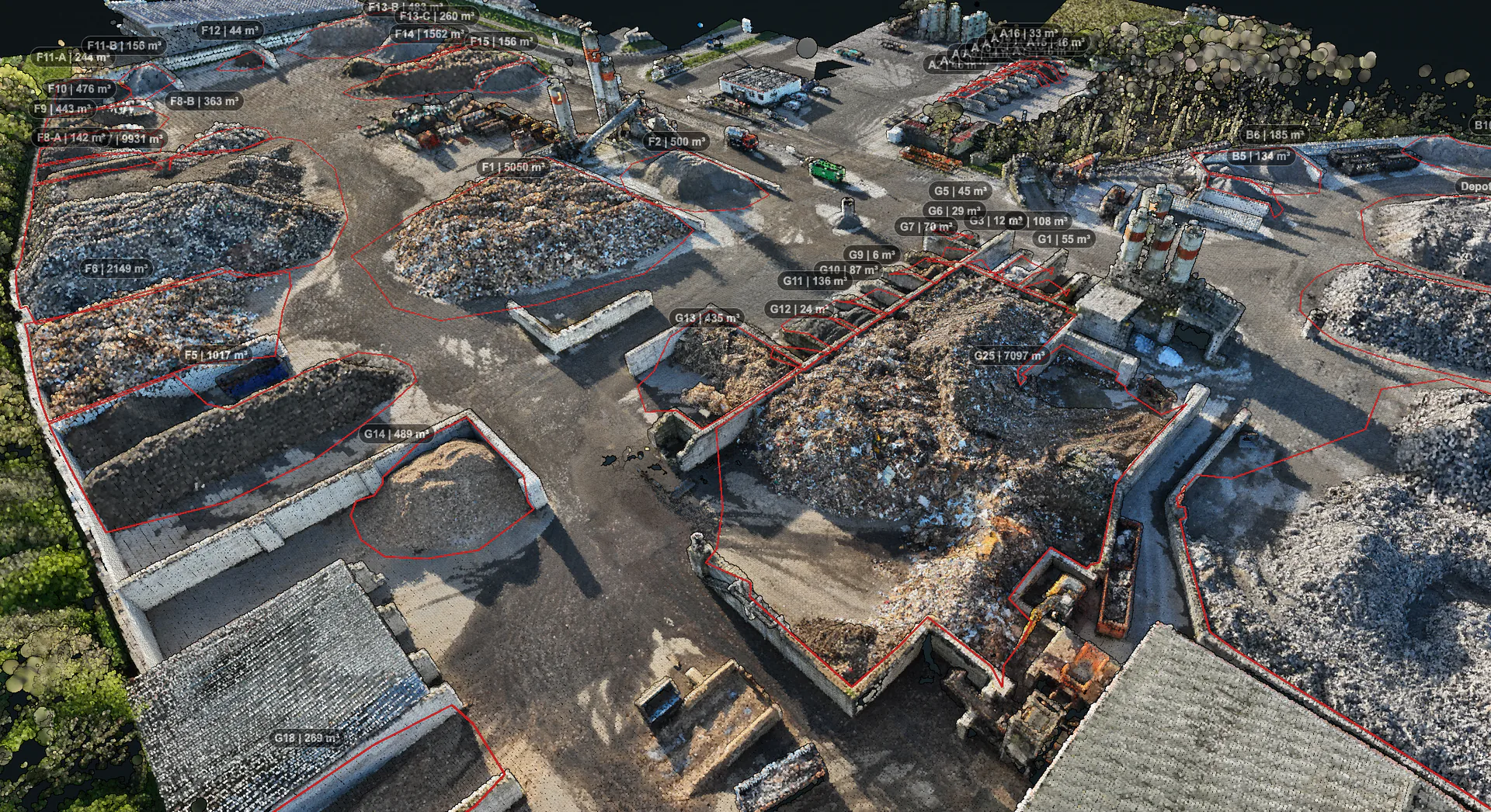
Most companies survey their stock once a year. Not because that is convenient, but because the accountant asks for it. It is an obligation you tick off, not an instrument you steer with.
Which is a shame, because how often you survey largely determines how much use the figures are. This article is about why surveying more often delivers something different from the same figure on more dates, and how to work out the right frequency for your yard. Including the answer to when surveying more often stops adding anything.
Survey frequency is how long you let an error run
Start with the most practical angle. Every difference between your records and reality starts at some moment and persists until you notice it. Survey once a year, and a difference that arises in week two can run for fifty weeks before anyone sees it.
Survey monthly and that is four weeks at most. On average an error runs for about half your survey interval. There is nothing more to it than that: your survey frequency is simply how much room you give an error.
And that is not only an accounting point. During that period you are planning transport, making commitments to customers and taking purchasing decisions, all on a figure you do not know has drifted.
One survey is a level; two are a movement
A single survey tells you how much is there. Useful for the balance sheet, but it is a photograph. What you need in the operation is the film: how much was used, how much came in, and whether that is running faster or slower than expected.
That information does not sit in a survey, it sits in the difference between two of them. Which means the number of surveys determines how much you can see at all. Once a year gives you zero movements. Twice a year gives you one very coarse movement over six months. Twelve times a year gives you a pattern in which you can separate seasonal effects, build-up and consumption.
Surveying more often also makes a difference explainable
This is the argument that pays off most in practice and the one you rarely hear. Surveying more often does not only catch a difference sooner, it makes that difference explainable.
Suppose at year end you find 2,000 m³ less than the records say. What do you do with that? You do not know in which period it arose, on which material, or through which process. There is a year of possible causes in between. In practice a difference like that gets written off rather than investigated.
Find a monthly difference of 150 m³ on one material stream and you have something else entirely. You know which month it arose in and on which material, and you can go and look at what happened in that period. Then it becomes a process question rather than a write-off.
That is how it works in practice too. AVG sets the surveyed stock alongside the stock records every quarter. Internal material flows never cross the weighbridge and therefore appear in no administration at all; that holds sector-wide, not just there. Comparing every quarter makes visible what otherwise stays invisible, and per quarter it is still traceable.
How AVG surveys six sites every quarterOnly if you survey the same way every time
There is a condition attached to all of the above, and it is important enough to state separately. Surveying more often only delivers something if every survey is produced the same way.
That sounds like a detail. It is not. Suppose your method consistently reads 3% high. Survey in January and April the same way, and both figures are 3% high, so the difference between them is almost exactly right: the error sits in both numbers and cancels out.
Have January estimated by one colleague and April by another, each in their own way and each off in a different direction, and the difference between those surveys contains both errors. The movement you are trying to measure can then be further out than either individual figure.
Which leads somewhere counter-intuitive: for steering your operation, a consistent method with a small known bias is more useful than one that is occasionally very accurate. You do not steer on the level, you steer on the change, and change can only be measured if the method holds still.
Survey as often as you decide
A practical rule for testing your own situation: your survey interval should not be longer than your decision interval.
If you plan transport weekly and make weekly commitments to customers but survey once a quarter, you are taking thirteen weeks of decisions on one figure that ages every day. That is not automatically wrong, but you should be clear that you are steering on an assumption rather than a measurement.
Three things decide your frequency
There is no universally correct frequency. The right choice follows from three properties of your own situation.
- Material value: at a high value per cubic metre, a small percentage difference feeds straight through into money
- Turnover rate: the faster material comes in, goes out and is processed internally, the faster differences build up
- What you use the figure for: production and transport planning needs current data, while supporting the annual accounts can manage on a lower frequency
How that plays out is clear from two customers who deliberately do it differently. Euregio Recycling, one of the largest recyclers of electric motors in Europe, surveys weekly. Material value there is high, so even a small weekly difference counts, and the surveys feed straight into production planning and transport planning. Weekly insight keeps that operation in balance.
Hooijer Renkum works with green streams such as timber and tree waste. There the materials move more slowly and the value per cubic metre is lower. Monthly surveying is the right call for them: more often would produce barely any new information.
At AVG, with six sites and a broad material range, it is a quarterly cycle. There the survey is mainly an instrument for holding the records to account and comparing across sites, and for that every quarter is ample.
| Frequency | Fits | What it gives you |
|---|---|---|
| Yearly | Stable stock, an audit obligation only | A figure for the annual accounts, no steering |
| Quarterly | Multiple sites, mixed materials | Support for the records and comparison across sites |
| Monthly | Lower value or slower turnover | Alignment with the monthly close, differences stay small |
| Weekly | High material value or fast turnover | Directly usable in production and transport planning |
| Per project | Temporary stockpiles and earthworks | A baseline and a final survey per project |
On earthworks the logic sits slightly differently, but the principle is the same. There it is not material value that sets the frequency but the pace at which the site changes. On an active project, weekly surveying is common, simply because enough happens in a week to want to know how much has been moved.
How this works on an earthworks projectWhen surveying more often stops adding anything
More often is not automatically better, and it is only fair to say so plainly. A survey only adds information if something actually changed between it and the last one.
If you hold a stable batch that barely moves, then at a high frequency you are mostly measuring your own survey noise. Two surveys differing by 1% on a batch nobody has touched tell you nothing about your stock and do cost you attention. At worst you end up explaining differences that are not there.
So the rule of thumb is: let your frequency follow the rate at which your stock changes, not the question of how often you could survey. A stockpile a third of which leaves in a month deserves a monthly survey. A strategic reserve that sits untouched for a year does not.
Why frequency used to be a budget question
If surveying more often delivers this much, why does almost everyone do it once a year? Because historically the cost sat with the survey rather than with the system.
As long as every survey is a separate job you outsource, frequency is a budget question. You buy as few surveys as you can justify, and that is precisely one: the one for the accountant. Every additional survey then has to be approved separately, which makes the most valuable use of all — surveying often and routinely — also the most expensive.
As soon as surveying becomes a fixed monthly cost rather than a price per job, the question changes. Frequency becomes an operational decision: you survey when it is useful rather than when it is justifiable. And it works the opposite way round from what you are used to: the more often you survey, the lower the cost per survey works out. That is the real reason the companies in this article survey monthly or weekly instead of yearly.
How we do it
AiroMap is built precisely for that: a fixed monthly fee rather than a price per job, an unlimited number of users, and a drone your own people operate. An extra survey therefore costs you half an hour in the field rather than a new order.
Because every survey runs through the same automated process, the figures really are comparable between weeks, months and sites. That is the condition set out in this article, and it is not something you organise around the edges: it has to sit in the method.
Want to know which frequency fits your yard? We come over, survey a site and set the result alongside your current figure. That shows you straight away how large the gap is, and that is usually the best starting point for the frequency question.
See how stock surveys work with AiroMapHow a drone volume survey works, step by step